The Lost City

I was going hiking in the mountains! Or at least that’s what I thought…Since arriving in Colombia last May, I have had Ciudad Perdida, also known as the Lost City, on my list of places to visit. Ciudad Perdida is an abandoned city in the Sierra Nevada Mountains on Colombia’s coast hidden away for over 350 years until its recent discovery in the past several decades. Known as the Machu Picchu of Colombia, it was recently opened to tourism by way of a four to six day trek through a mountainous jungle. As teaching fellows started planning their trips for a weeklong school holiday in October, I knew I was going to do the trek.

My original plan was to complete the trek in June, but of course, I was too sick then to walk down the street let alone up a mountain. This time, though, unlike last, I was healthy and ready – or so I thought. But something wasn’t right. I was clear about wanting to go to the coast during the school break and clear, within myself, that I wanted to travel on my own due to my general aversion to large groups and love of solo adventures. But one thing was tripping me up – I wasn’t the only one going to the coast. There was another group, or several groups, of fellows who also had similar plans during the break. Given this knowledge, I felt a pressure to join them and was afraid of saying, “Hey – so we’re going to the same place but I think I’m going to break off and travel on my own…” out of fear of what they would think and that they might eventually, upon return to our normal post-vacation lives, abandon me, leaving me friendless and alone. The Ciudad Perdida trek, however, was the perfect opportunity to do my own thing. Suddenly, it went from being something I solely wanted to do for myself to something I wanted to do to get away from others. I needed space but was too afraid to ask for it.

Then, rather than being upfront and honest about my thoughts, I disconnected from myself. The first sign of dysfunction was obvious, I didn’t sleep well the week leading up to the trip. Of course I ignored the insomnia and excused it as a case of nerves for the upcoming challenging and unfamiliar adventure. What I didn’t realize was that in my head, I was turning the trek into a thing, an escape, and getting very, very attached. So when it got cancelled for reasons way outside of my control (aka a hurricane) the day before I was supposed to leave, I was hit with serious disappointment but even more than that – panic. Because, like the city, I too was lost. And I’m embarrassed to admit it but I had been using the city and the trek as my excuse to get found.  Somewhere deep inside me, I hoped if I did the physical hard work to hike to the city, the emotional work would follow. I was banking too much on external circumstances to do another reset after disconnecting from myself once again.

What was clear, most of all, when I processed my disappointment regarding the cancellation is that I had expectations. And got attached. And in my mind I turned this hike into a journey to freedom. Freedom from resentment I had for myself for not using my words, caring about what others thought and letting that influence the way I lived my life. I thought that walking away from the group to embark on the trek would be following my own path. What I didn’t realize is that I was childishly running away and hiding behind an excuse – the trek – to avoid using my words and owning my needs.

I don’t know why but I told myself that at the top of the mountain in the place where the city used to be, I would find myself and my voice. This challenging journey to the Lost City would bring struggle, clarity and eventual relief and rewards. And maybe it was true. But I didn’t need a hike to do that. Nothing external could get me to the places I needed to go myself. In addition, I couldn’t use it as an escape either: a trek away from the boundaries I needed to set and away from the fears I had of being abandoned. Rather than trekking to independence, like I thought I was doing, I was running away to hide in the mountains. Of course it got cancelled, the Universe was laughing at my insanity.

The hike was cancelled. And now I two plane tickets, an eight-day trip and absolutely zero plans. What to do next? My wonderful mother and father had wonderful advice. Do whatever you want. Maureen reminded me that how things proceeded going forward was up to me. I could make the vacation great or I could make it terrible. It was my choice.

So the next day, I set off with zero plans, zero itinerary but with the very, very clear feeling that I wanted to travel on my own. I told the group I was going to do my own thing and, for what may have been the first time in my life, decided to spend a week living day to day in the moment and without plans.

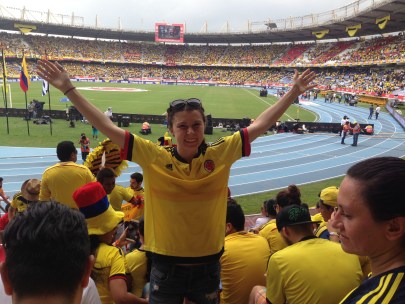
And do you know what that led to? A spontaneous bus ticket to a little pueblo by the ocean where I swam in the sea, saw snow and floated down a river in the middle of the jungle. A spur of the moment ticket purchase to the Colombia/Uruguay World Cup Qualifier soccer game because, fuck it, why not? It led to sleeping outside in a hammock in Tayrona National Park as I listened to the ocean crashing around me and, later, a long overdue dance party in Cartagena. I’m not going to lie…it also led to some serious crises of confidence, tears and a very hard lesson or two. But overall, it led to me falling asleep nearly every night with a sense of joy in the center of my heart because I knew that I was waking up each morning and following it. It led to me asking myself every day what I wanted and listening, for once, because it’s not like I had other plans.
img_6691

The HIGHLIGHT of my Colombian experience so far

It led to me being alone. And loving it. And once again wondering why, if being alone felt so good, did I keep settling for anything less fulfilling?

But more importantly – why did I keep abandoning myself, my wants and my needs to try to prevent others from abandoning me? What was I so afraid of? Few things could be worse than continuing my self-inflicted torture where I kick and scream internally while sacrificing myself and my needs to try to fit in with others and not miss out. What I need to do is accept our differences and letting them be them and me be me, instead of wishing one of us was different and staying hooked.

This fear and pattern, like many that I have, stems back to childhood where I acted out of fear to avoid my mother’s punishment and threat of abandonment. The wound started then and was later ingrained deeper as the Hunsickers entered the picture and my mom continuously chose their needs over my own. As I started to realize the inequity in the household, connect with myself and try to live in authenticity with the needs that followed, problems started to arise. The closer I got to myself, the further I got from my mom. Every time I stepped out of line, whether it be at the age of eight or the age of 18, I was upsetting the balance of our relationship. If I offset it too far I was afraid she would be gone. And eventually she was – but in retrospect, I’m not really sure she was ever even there. If she were, there would have been no consequence to me connecting with myself, having my voice and asking for my needs. If she had been there, there would have been no threat to losing her to anyone. If she had been there, I would not, too this day, live with the irrational fear of being abandoned because it never would have even been a threat. And if she had been there, I don’t think I ever would have been lost in the first place. There would have never been a need for me to disconnect from myself.

There are two problems with the fear of abandonment. One – anyone who does not support your in your needs, your voice and your quest to find your true self should not be in your life, and thus when and if they leave it should be a blessing – not abandonment. And two – the only thing worse than being ‘abandoned’ by others is abandoning yourself. And by living life leading up to this vacation trapped in that fear of being abandoned by others, I did exactly that: I abandoned myself.

After staying confined within this fear for the majority of my life, I clearly had some work to do to break that pattern. Unfortunately, no trek that I set off on to run away was going to help me reconnect. That would have been just too easy. Instead, I had to follow Maureen’s advice and do whatever I wanted.

Thrilled after a 5:00 a.m. wake up for the sunrise in Tayrona National Park

After leaving the group, I went off on my own adventure. And each day as I checked in with myself, I slowly started to reconnect. I found a little bit of myself as I made the decision to spend the night in Palomino rather than go to a group beach day in Santa Marta and a little bit more as I silently floated down a tube on a river in the middle of the jungle the next day. Another part of me was found as I took on the overwhelming city of Barranquilla, driven by my determination to make it to the soccer game. I reconnected every morning when I set an early alarm to walk the beach during the sunrise, and particularly, during one 6 a.m. beach walk where I, for the first time ever, stood on sand and stared at snow.
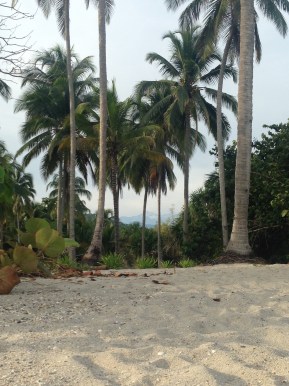
img_6656

Best of both worlds – beach and snowy mountains (in the distance)!

Little parts of me started to reconnect through every decision I made during the trip. I took ownership of the week and now I need to do it for the rest of my South American experience. And my life. That is when I will truly find myself: when I can wake up everyday, check in with what I want to do and what makes me happy and do it rather than being so concerned about the others opinions and their potential to abandon.
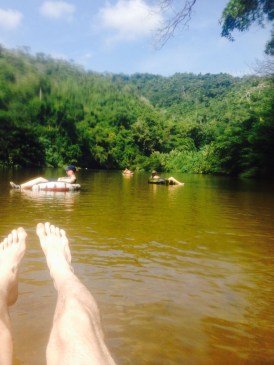
img_6672

Tubing through the jungle in Palomino

I had no right to be looking for the Lost City. What I needed to spend my time on was the lost Lucy. The little girl that years ago locked herself up to please others and tried, at all costs, to avoid being found and rejected. I need to remind myself that the only way to cure my fear of abandonment, and end my pattern of trying to please others, fit in and resisting setting boundaries, is by not abandoning myself, which ironically means not trying to please others and actually setting boundaries. While in many ways I succeeded during this trip, there were also times that I failed pretty miserably. But that is life and life is learning.

I disconnect and reconnect from myself on almost a weekly basis. I have surges of power where I take charge and then flickers of doubt where I recline. But now I am aware of it. And the moments where I lose myself feel more uncomfortable than they used to because at least now there is some sort of connection. For so many years there wasn’t. Up until recently, life was lived in complete disconnection and constant fear.

On this vacation, I wanted to go looking for something that was lost and in turn, be found, but to do that, I envisioned trekking through the wrong jungle and facing the wrong obstacles. My trek is internal and can be embarked on now matter where I go.

When I ran into the ocean in Palomino, my first surge of freedom during this vacation, I started laughing as I was consumed by relief and realized how far I had come. I was swimming in the Caribbean Sea, despite my childhood fear of oceans. I was living abroad in a ‘third world country’ despite just about every path I was expected to follow as a child by my family. I was probably, at this point, speaking more Spanish than English and tapping into a long repressed gift and love of language. These were my choices and the path to follow them appeared because, at some point in time, thanks to the wonderful support of Maureen, my dad, Marae and Charlie, people who would never abandon me, I started to connect. Despite the times that I faltered, I was making my own decisions, living my own life and reconnecting. Despite everything, I was making progress.

What Does It Mean to Be Lonely?

I haven’t posted in a while. And that’s because I haven’t written in a while. Instead, I have been meeting new people and spending time with old, I’ve been working and working out. I have been traveling on the weekends, settling into a new apartment, exploring Pereira’s downtown and slowly going crazy. These past several weeks my calendar has been full, which I thought would have been a good thing, until I woke up one day completely disconnected from the joy I had been so in touch with just a month ago and realized that it’s not.

At one point, in the midst of this chaotic schedule, I stopped sleeping and spent a week running on a 1:00 – 5:30 a.m. sleep schedule. At first, my students laughed at the bags under my eyes and my excessive yawning in class. By the end of the week, though, they were coming up to me asking if I was tired. And then if I was sick. And then if I was okay. I said yes, I was just having trouble sleeping, and thought nothing more of it.

One Friday night, I was sitting with a new Colombian friend in a bar. I told him I had had a good week but hadn’t slept well. He immediately jumped in and explained to me that insomnia often has emotional roots. What was really going on? “Nothing,” I explained, “I’m fine.” Fine doesn’t work for Colombians. They see through every single excuse and they aren’t afraid to tell you. Different issues I had been dealing with throughout my adventures flashed through my head. Family? No. Being out of control? No. Having my voice? No. I was lost.

“Lucy,” he said, “you are away from your family, your friends. Do you miss them?” I laughed as I translated his Spanish words in my head and scoffed at the idea that homesickness could be what was troubling me. “No. I mean yes, I miss them, but it’s normal for me to be far away. I’ve lived away from home for five years. This isn’t new. I’m not lonely. That’s not what this is about.” He assured me he was there if I needed to talk more. I thanked him for his offer and changed the subject.

I continued the evening feeling agitated. The feeling carried over into the next morning and bled into the evening and the following day. Finally, on Monday, I started the morning with a meditation focused on resistance, something I had tried earlier the previous week as I noticed my heightened agitation. Nothing had come up in previous sessions – most of the time I dozed off because I hadn’t been sleeping, but that day, something did.

Writing. I hadn’t been writing. That had been my main form of processing over the past several months and by pushing that aside I had stopped reflecting. I had been staying busy in almost an addictive way as an attempt to avoid a truth that I didn’t want to accept. Something told me the activity that I was avoiding the activity that I needed to do so I dragged myself to a coffee shop that morning and as I sat down, alone for the first time in what felt like forever, out of nowhere, I began to cry. All at once, it hit me. My friend had been right. I was lonely.

That is what I had been afraid to admit. I was surrounded by foreign teachers who always wanted to hang out and had spent the past week (or several weeks) with a schedule packed full of activities in an attempt to make Colombian friends. All of that should have equated to feeling being connected to others but guess what? It didn’t. I was still lonely.

The views in Medellín, Santa Rosa and Manizales, which were some of the only benefits that came from staying excessively busy. 

My brain spun to find answers to the situation that didn’t quite make sense. Maybe I was missing the connection that I had with my family and a couple of close friends at home? The people here were still new and so was the city. I hadn’t yet found a best friend, a ‘person’ here. I told myself I needed that. But that kind of connection doesn’t just happen right away, I reminded myself. It takes time to build up and develop a sense of understanding and a sense of trust. I hadn’t been here long enough. I wasn’t at that place with anyone. But I was trying so hard find a shortcut to make that connection happen.

So then I changed my story in my head, I was missing a true connection with others, and went down that mental tangent. And then, of course, as I was spinning that story, simultaneously listening to Apple Music on shuffle, a song popped up that I’ve never heard called You’re the Cure, by Farewell Milwaukee. A small voice appeared in the back of my mind. And I started laughing. And then I swore. And then I called my mom, Maureen, because she always knows what to say.

On the phone I purged my whole story about being agitated and feeling lonely and not having a best friend and being alone to her. She listened, with her impeccable ability to see right through 10 minutes (or more) of me talking in circles and find the main point, and responded with a statement that hit the nail on the head. “Lucy,” she said, “often times we feel lonely when we disconnect from ourselves.” So I paused as her message lined up exactly with the coincidentally accurate song from minutes before. Thanks to her wisdom, in less than a minute, everything was clear.

I had spent the several weeks 110% disconnected from myself. I traded my precious writing time for coffee meetings. I traded my decompression time after work for extended conversations in my apartment’s kitchen – afraid I would miss out on something by recharging in my room. I texted too much in an attempt to fill my calendar with plans. I didn’t read. I didn’t write. I didn’t breathe. I acted out of impulse. Out of fear. I was so afraid to be alone.

So now, I have a confession to make. It might be startling. It might go against everything you think you know about me. You might, like many people before, not believe me. But I need to be honest.

I am an introvert.

No, this does not mean I am “shy and reticent” person like the dictionary wants people to believenless you consider someone who runs around downtown Colorado Springs in a leopard print onsie shy. Instead, what it means is that I need time alone to recharge so I don’t go insane. Introverts, rather than getting their energy from outward stimulation, like large groups of people, get their energy from themselves. Even with that knowledge, instead of honoring that part of me, I kept exhausting myself in a desperate attempt to not be physically alone. I kept running the track in my head that told me if I was alone then I would miss out on something and not get the full Colombian experience. I keep comparing myself to those who live their lives doing everything they can to avoid being alone whether they are simply extroverted and enjoy it, or like me, are running scared.

I need to remind myself that the best 48 hours of my life were spent on a beach, alone. Some of the best weeks of my life were spent traveling through Spain, alone. And some of the most powerful months of my life have been spent bouncing from country to country and city to city, this year, alone.

Being alone does not mean that you are lonely. It just means you are by yourself. And these past weeks have reminded me that you can feel lonely even when you are not alone. For me, I often feel less lonely alone than I do with others, especially if there isn’t a true connection. Welcome to life as an introvert. Because really, like the song said, I am the cure, I have to be my own best friend whether or not I magically find a person here or not. And even if I am fortunate enough to find someone with whom a relationship is effortless, I still need to continue to be my own best friend.

In the meantime, I have to stop hoping that quantity of social interactions will, by process of elimination, lead to quality. Forcing friendships, forcing a full calendar, and resisting my much-cherished Lucy time is not healthy because, as an introvert, it is harder to spend countless hours being with somebody just to numb the feeling of being alone than it is to actually be alone.

I miss my family and my close friends. I miss people who I knew, without a doubt, had my back and whose back I had as well. But more than anything these past few weeks, I have missed myself.

So while my friend was right that I was lonely, the cause was exactly the opposite of what he had been thinking. My kind of lonely didn’t fit the definition, “sad because one has no friends or company,” which, in case you were curious, is how the dictionary defines loneliness. I was lonely because I was trying to do too much, meet too many people, have too many plans. The solution for my current state was the exact opposite of what the definition said I was lacking. I needed to be alone.

I need to fully accept, and embrace, my introversion because it is who I am and there is nothing I can do to change it. An extrovert’s costume will never fit me, as much as I sometimes I wish it did. I need to reconnect with myself. I need to read, because I love it. Meditate and do yoga, because it calms me down. And most importantly, write, because more than anything, it helps me process. I need to breathe and live my life and take breaks and recharge and give myself personal days every once in a while, because, really, new friends, a country filled of adventures and a full calendar just aren’t enjoyable on an empty tank.

img_6554

My view upon arriving in Marsella, Colombia

With this new realization (more like a reminder of an old realization), I woke up one morning, grabbed a book, a journal and my headphones and hopped on a bus to Marsella – a little pueblo that I had heard of but knew nothing about. For the first time in two months I was adventuring alone again. A few speed bumps aside, the day was wonderful and a fantastic reminder that some days, and some adventures, are just better spent alone.

The Right to Grieve

“Lucy, do you remember the boy I told you about on the first day of class? The one who played guitar?” My co-teacher asked me. With his strong accent I couldn’t quite understand him. “Guitar?” I asked to clarify and mimed playing one. “Yes,” he said, “He died this weekend.” I stopped. And stared. Hoping that just like the word guitar the word died was lost in the confines of his accent. I didn’t misunderstand. I heard correctly. Daniel Felipe, one of the students I had gotten to know best during my time at school, was dead. He had been killed in the streets. I stood up, walked to the bathroom, locked the door and cried.

Colombia is changing, of that I am certain. It is no longer the murder capitol of the world nor the country ruled by cartels. Incidents such as this aren’t normal anymore. At least that’s what a friend here said. These types of killings, at this age, are rare, unless you live a lifestyle that invites it. Which he didn’t. So it was random. And for that reason even more tragic. There are so many times I have forgotten where I am because this does not feel like the ‘third world country’ that I was warned about entering. Much to my surprise, I have felt safe. And yet with this incident I was hit with a harsh introduction to reality.

While I have had a few encounters with death in my life, murder is something that is completely foreign to me. The thought of a ninth grade boy getting killed on the streets is something that I can’t fathom. Not in the bubble that, up until this point, has been my world. When explaining what happened to my fellow foreign teachers, I said, “This kind of stuff just doesn’t happen in the States.” And then I paused and backpedaled as my privilege smacked me in the face because it does. It is happening now in cities across the U.S. There is violence. There are murders. There are tragedies just as senseless as this one. It happens in the world, it happens in the States and it happens here.

One of my first weeks in Colombia during a cab ride, the driver, upon learning I was from the U.S., warned me about the violence in my country and passed on his condolences. My world was not that world. I have been sheltered from the violence and for that I am grateful. But now here I am exposed to my first tragedy, living side by side to the dangerous streets that I never crossed growing up and feeling uncertain as to how to move forward. I didn’t know how to react after becoming distinctly aware of my privilege or how to navigate a situation that is so unfamiliarly tragic surrounded by people who have seen it before.

I was uncomfortable admitting my sadness, hence the reason I locked myself in the bathroom and refused to leave until the last bit of red had faded from my swollen eyes. I didn’t feel like I had a right to the tears. I was not Daniel Felipe’s friend, nor his family. I had only been his teacher for a month. My tears hadn’t been earned by years of knowing him and yet it was clear that after only a month not only him, but all of my students had had an impact on my life. Outsiders couldn’t see their impact though. So as Don Orlando, the school coordinator, made the formal death announcement to the students during the last ten minutes of my final class, I tried to hold back my tears. This wasn’t my school, this wasn’t my country. I was a guest in all of it. Because of that, I told myself that I had no right to be impacted. And yet there I was, mentally willing my eyes to serve as barricades for the tears trying to burst through, afraid that my students, or my co-teacher, would see me crying and afraid that they would wonder why.

IMG_6058.jpg

One of my ninth grade classes

“El estaba una victima del violencia en nuestra pais,” Don Orlando said over the loud speaker. He was a victim of the violence of our country. His body had been found that morning in an abandoned street. He had been robbed and killed walking home the night before. He played five instruments and the rumor was that he was murdered for one of them. Around me some students cried, others were silent and some poked each other and made faces as if this was not a big deal. I still held back my tears. It was only when I rushed out of school at the end of the day and started sobbing on the street corner that I really allowed myself to let go.

In talking to friends this past weekend I told them that I adored my students. I told them about my students who had had babies and then returned to school. Their commitment to their education was impressive. I told them about the older tattooed boys who waited outside school to pick up my students, their girlfriends, on motorcycles. A foreign feeling of concern and protectiveness for these girls passed over me every time I walked past these unfamiliar boys. And even before he died, I told them about Daniel Felipe. One day in class he took me through his sketchbook showing me the beautiful drawings that he had spent months pulling from his head to put on paper. He showed me pictures of his instruments and told me about an upcoming performance of his in the city. I told him that I was planning to go. I am sad that we will both miss it.

What I told my friends was true. I adored my students. But it wasn’t until days after our conversation when this happened and one of them was lost that I realized that I really, really did care. Deeply. These kids, who I had been so hesitant and resistant to teach due to their age, were amazing. And I loved them. And I am so sad that one of them is gone.

And yet I still felt like I didn’t have a right to the sadness.

But who owns sadness? Who dictates who gets to feel what and, in bad situations, who shares what percentage of the pain? Unfortunately, in our world, there is more than enough sadness and grief to go around. Grief cannot be owned, divided or scaled. Sadness is just sadness. Grief is just grief.

You have a right to all of your emotions. To your happiness, to your joy, to your sadness and your pain. You have a right to feel. And to cry. And to experience whatever emotions you need to experience. Feelings are feelings and one of the few things in life to which everyone is entitled. But for some reason, I was having such a hard time allowing myself that right.

The next morning was surprisingly harder. I woke up fine, went for a run, ate breakfast and started to process in the only way I knew how: writing. And then I got a text from my mentor. My normal classes, with my normal students, were cancelled that day for the funeral. She asked if I could come in to work with the younger grades. Contractually, I was not obligated and emotionally I was not capable, however, I fell into my people pleasing pattern and was afraid of claiming the sadness that I felt but did not feel like I had earned so I responded, “Yes, of course,” even when every part of me was desperately yearning to say no.

For the rest of the morning I cried. Relentlessly. I kept telling myself that there was no reason for me to stay home instead of going to school. Clearly I was ignoring the evidence that was flooding down my face and drowning my clothes. I imagined myself riding the bus to school and sitting through five classes with students who I didn’t yet know all the while trying to pretend like everything was fine. It felt like torture. Despite that, I was still planning to go in because I was so used to stomping on my feelings while soldering on and, in this case, too ashamed to admit my sadness to those who I thought deserved it more.

IMG_6319

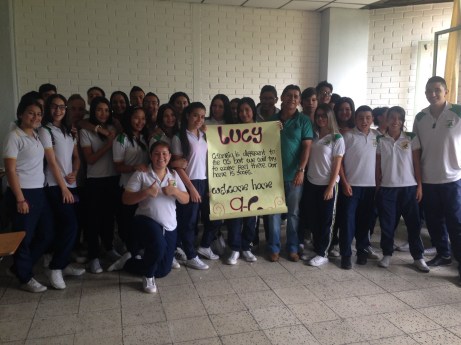
A poster made by Daniel Felipe and his classmates presented to me on our first day of class

In the midst of my resistance, I called Maureen who helped me realized that I was allowed to be sad, what happened was sad, and that I needed to take care of myself in whatever way I could. On my way out the door to school, still crying I might add, I ran into Rowan, another foreign teacher. He walked towards me and gave me a huge hug. Then, he told me what I hadn’t dared think myself: I didn’t have to go in today. With his words, and the coaching of Rob, another fellow, I called my mentor and shook as I explained that I was affected by what happened and needed to take the day off to take care of myself. Upon admitting my sadness and owning my grief, I melted onto the kitchen floor in a puddle of relief and tears.

My students are incredible. And if I love them, which I do, then I can celebrate them, worry for them and, in the most tragic of circumstances, mourn for them. And even if I didn’t have the privilege of knowing or loving them, I could still mourn for Daniel Felipe, the incredibly talented ninth grade boy who was senselessly and tragically killed in the street. Everyone has a right to that sadness.

The Man on the Road

A tattered red and white Ford station wagon, straight out of drive-in movie, pulled up in front of the house in Viñales. The collectivo, a shared taxi back to Havana, was twenty minutes early. That was new. I hugged Darelys and Rigo, the amazing Cuban couple who had hosted me the past week, then passed my bag to the driver. He threw it in the back as I squeezed myself into the middle row of the car next to an Italian couple. As we waited to leave, Darelys came to the side of the car and grabbed my hands. “Cuídate,” she said, take care.

Slowly, we pulled away from the beautiful green house and made our way around the corner to pick up the last group of passengers. I chatted with the Italian couple and two other Italians who were sitting in the front seat as we emptied out of the car to make room for a trio of French travelers. The driver played around with the jenga board of bags in the back as the youngest and tallest of the three French travelers inspected the car. He turned to the driver, after seeing the open seat for him in the last row, and looked up at the roof of the car. “I would rather be strapped up there than sitting in the back of that car,” he said to him in Spanish. We filed into the car and I decided, given my height, to take his place in the back, in exchange, he carried my bag on his lap.

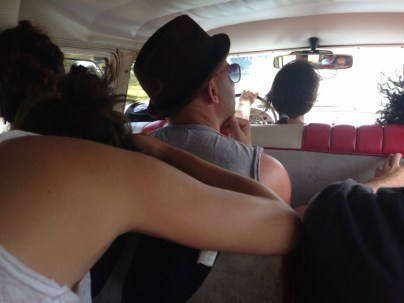
Finally, with the small car full, overflowing with people, bags and energy, we started on our journey. Latin music was blaring from the speakers as the old car buzzed down the dirt road. The driver was talking in Spanish with the two Italian travelers in front bench, the Italian man was chatting with the younger French man in front of me in English. An older French man sat in back and alternated between French and English while conversing with me, a French woman and the Italian woman in front of him. Languages changed like television channels as everyone in the car familiarized themselves with their fellow travelers. The 1940s Ford contained a quilt of cultures, patched with a various mix of languages, crammed together in the same space all with their own story. Outside, the indescribable green landscape flashed by our window as we cruised through the winding hills. The driver sang to us in a strong, deep voice, his hand tapping to the beat outside the window. Occasionally, he would stop in the middle of the highway to answer his cell phone as cars passed in the lane beside him. Once his call ended, he picked up the speed and carried on like nothing had happened. Throughout it all, we were unphased.

IMG_5382

Our full collectivo back to Havana

My heart was intoxicated by this unique experience and my ears jumped around the car hungrily trying to comprehend the various languages. I reveled in the opportunity to refresh my French and practice my Spanish and comforted by the rare opportunity to fall back into speaking English. With each mile, I missed the beauty of Viñales and the relationships I had made there more and more but, at the same time, I was excited to get started with my new adventure in Colombia. I just had to get through one more night in Havana.

Viñales was my saving grace in Cuba. Its unbeatable geography and vegetation coupled with the quaint, quite town and authentic people made up for my bad impression the country based on my time in Havana. After counting down the days until my departure for weeks, I was suddenly feeling sad about leaving. Looking down at my phone, I was comforted to see a text from a new friend in Viñales. “Me puse muy triste al igual que la mujer de la casa cuando vi que te ibas…que tienes muchas personas en Cuba que te quieren,” he wrote. I understood the message, thanks to my accelerated real world Spanish lessons in Cuba, and smiled. “I was very sad to see you leave, same with the woman of the house…you have many people in Cuba who love you.”

IMG_4910

The hills began to fade as we got closer and closer to Havana. Right as we crossed into the city limits on the highway, the French girl sitting next to me screamed. My gaze jerked upwards trying to figure out what happened. The driver slammed on his breaks the car and began to pull the car over as he pounded on his dashboard desperately cursing in Spanish. I assumed our car broke down until I looked to my left to see a body lying facedown on the road. Next to it was a blue, antique American car with a freshly smashed windshield stopped perpendicular to the highway. Oh my God. I turned to my right to see the young French man covering the eyes of the sobbing French woman as we slowly drove by the body. The tension in the car was strung tight like a rubber band waiting to snap as we all absorbed the scene behind us. Seconds later, fast paced French and Spanish shot through the as everyone tried to figure out what had just happened. The French woman, unable to speak, continued to cry, then raised her hands miming a person coming out of nowhere onto the highway and a car crashing into him. Sitting in the middle seat, she had an unobstructed view of his body being thrown across the highway. I hadn’t seen the accident happen as my view was, thankfully, obstructed by the head of our driver, but I still felt nauseous and on the verge of tears.

Pulled over, we sat in silence processing, the energy in the car still abuzz but now panicked rather than joyful. Suddenly, the driver shouted, “Está vivo,” jumped out of the car and ran across the highway. He was alive.

Cars and ambulances stacked up behind us turning the previous freeway into a parking lot. Occasionally, one of us in the car would dare to glance back to see what was happening but the haunting sight of the man in white shirt and jeans lying on the highway stopped our glances from lingering.

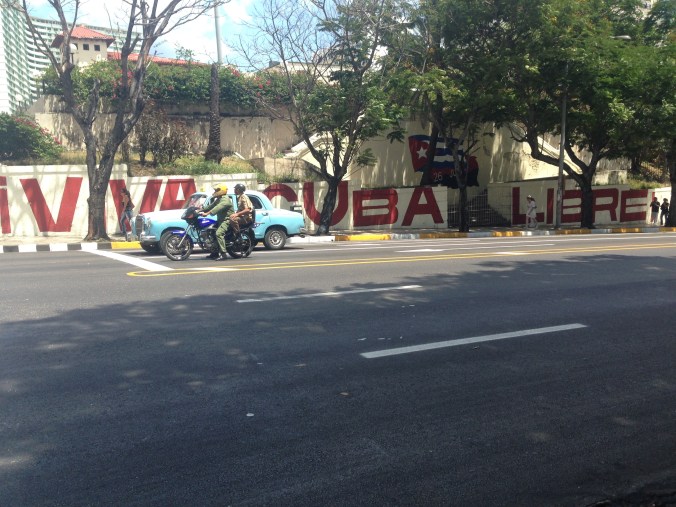
Propaganda on the highway back into Havana

After about 20 minutes, the driver came back to the car in an air of exhaustion. “Está vivo,” he whispered as if he wasn’t sure how much longer it would last. Without another look behind us, we drove off in a heap of exhaust towards the city. There was no more music and the silence congested the air in the car with despair. The driver muttered to himself in Spanish, “Havana es loco. You come here and this is what happens. The people are crazy. Havana is crazy.” His singing had stopped and his reflection in the mirror showed no traces of the infectious smile that radiated throughout our drive in the countryside. As we got closer to the city, the silence in the car got stronger as the noise from outside increased. The luscious green hills transformed into crumbling buildings. The calm highways changed into congested roads. It was hotter. Everything – the air, the energy, the people – felt heavy.We drove through familiar streets, past famous monuments and cultural icons. For the first time in a week, my countdown to leave was back on. Only twenty more hours and then I can leave, I thought. Next to me, the French woman continued to cry.

¡Bienvenidos a Cuba!

Today, I am closer to Miami than I have been in nearly a year, however, I have never felt further away. 24 hours into my three-week stay in Cuba, I don’t feel anymore adjusted than I did upon my arrival yesterday. I feel confused, frustrated, isolated and lost. Also, intrigued, excited and curious. And again, confused. Everything is new here.

Costa Rica is a country where you could get by being an American. You could spend weeks in the country without exchanging a single U.S. Dollar. You didn’t speak Spanish? No problem. There, being an American seemed normal. Walking down the streets of Nosara wearing a Twins hat, my one piece of clothing from home that really represented where I was from and the city that I had been trying for years to leave behind, I would have countless people walk up to me point out our shared roots.

In Cuba, it’s not like that. In Cuba, nothing is American. The currency makes no sense, the Spanish is so uniquely accented that it is nearly comprehensible to my novice ear. At least the streets make sense. Here, unlike Costa Rica, they have something that resembles addresses which makes navigating so much easier. If it was any harder, I would probably never make it home as there would be little point in asking for directions because I likely wouldn’t understand them anyways.

This is what I signed up for. When I announced that this would be a part of my itinerary I received several ‘are you crazy?! and at least one “you’re going to get arrested” reactions. Being here now, I realize that, yes, maybe I am crazy but no, I am not going to get arrested. Entering the country, despite all words of caution on internet blogs, is not all that difficult. I received no reaction to my passport while going through immigration even though I had been piecing together Spanish phrases in my mind to explain my entering the country. In fact, in the end, it was more difficult to get into Costa Rica than it was Cuba. Who would have thought.

IMG_5062

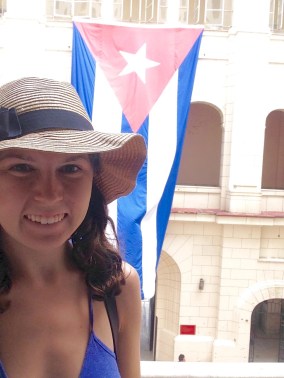
Made it to Cuba!

It will get better, in that I am confident. Last year, I travelled to Spain on a similar, last-minute, ‘what are you thinking?!’ trip. My knowledge of Spanish was nearly non-existent but I left, three weeks later, fluidly conversational with a new appreciation for the culture.

This will be hard. I came to the realization on the eve of my departure for this mysterious, isolated country that this will likely be the hardest part of my trip. Communication outside of the island will be incredibly difficult (even more so because my phone refuses to accept a Cuban SIM card), I will be speaking solely Spanish and the currency is just about as confusing as it gets. I can do it though. I know it. With each challenge, there will be a lesson, and those are the kinds of lessons that you can’t learn unless you are doing something crazy (like traveling alone as a young woman to a communist country that barely speaks any English with little to no connection to the outside world).

Bad Country

The vast majority of these next seven months I will spend traveling alone, however, my last week in Costa Rica I was fortunate enough to have a travel buddy. Brandon flew in from Colorado and met up with me in San Jose for a cross-country Costa Rican road trip. The first half of the week was fairly smooth with the exception of me constantly fighting with the GPS, him getting bit by a scorpion and me subsequently having a panic attack because of a newly discovered scorpion phobia. Overall, it was nice to have a friend along for the ride and a welcome change of pace from traveling alone.

There was one day, though, where everything seemed to go wrong. Halfway through the week, we half-heartedly left the cloud forests of Monteverde for a six-hour long drive to the coast of Mal Pais. For those who don’t know, Mal Pais translates into Bad Country. My dad jokingly sent a text stating he hoped the place was better than the name. Unfortunately, in the first 24 hours, the translation was spot on.

IMG_4814

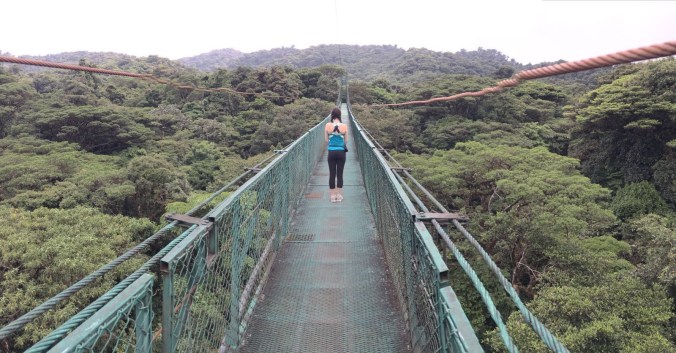
Over the treetops in Monteverde, our favorite stop on the road trip

The drive, surprisingly, was fine and unlike the first day of the road trip, I did not take us over an hour off the intended route (while I will 100% admit that I am a horrible navigator, I still blame that on the GPS). After hours of Latin music and Rihanna, who Costa Ricans seem to love, we finally pulled up to a beautiful beach house in the sleepy surfer town. We were shown around the house and informed that both the laundry machine and the TV were broken. That was no big deal, however, when I pulled out my phone to send a whatsapp to my parents stating that I was safely in the next destination, I realized that the WIFI was also broken. Given the fact that I needed to finish the online component of my teaching certification, finalize plans for Cuba and tell my parents that I was safe meant that not having WIFI was a bit of a problem. No worries, we were told, someone would be over to fix it soon.

About twenty minutes later, as we were getting ready for dinner, a middle-aged man showed up and started working on the WIFI. The man spoke no English, only Spanish, and so I was the designated translator, not that I knew much vocabulary related to the internet or technology. Essentially, I was useless but I was trying. And so was he – desperately. To be honest, though, it was clear that he had absolutely NO IDEA what he was doing. He kept pulling up Japanese anime cartoons that described how to fix Internet routers. They weren’t helping. He kept trying and trying but the signal wasn’t working. He got so desperate that he called over his two kids, ages nine and six, to serve as translators because apparently I wasn’t doing a good enough job. Finally, several attempts later, something worked. His relief was mixed with shock as we had full WIFI signal and drove off to dinner.

After returning from dinner, I walked by the laundry room and noticed that it was completely flooded. Not sure what to do, Brandon started sweeping out the water while I called the caretakers of the house. Within minutes, they were there grabbing the broom out of his hands and shooing us away. A little while later, they came back and informed us that the laundry machine now worked but the air conditioner was leaking from the ceiling. They would be back tomorrow to fix it. Cool.

In the middle of the night it started to rain. Due to the rain (which didn’t seem too strong) the power went out. With the power went the AC and throughout the remainder of the night the interior of the house heated up to the toasty 90 some degrees outside. Of course, WIFI also turned off with the power.

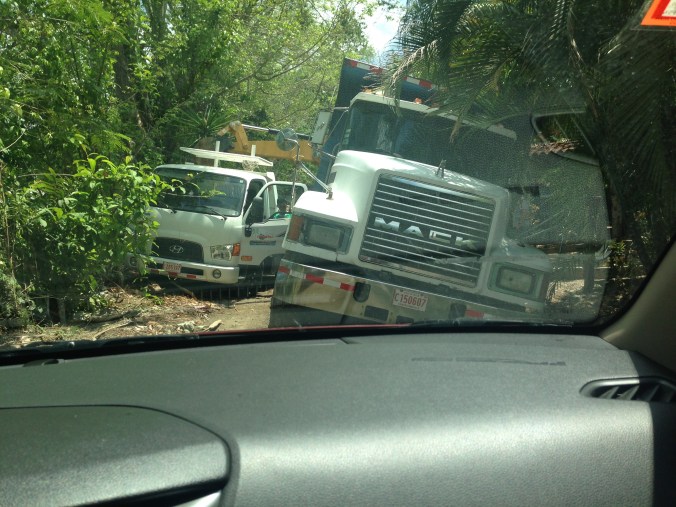
At some point the next morning, the power came back on and the laundry room had flooded again. We left for breakfast only to be flagged down on the gravel road leaving the house that there was a problem on the street ahead. Not sure what it was, we continued only to see a huge semi truck had sunk into the ground from the rain and was stuck on the road blocking the only exit to the main street. Awesome. Thanks to Brandon’s incredible driving skills, though, we were able to drive up the side of the road on a slight hill and narrowly pass the truck to get to the street. By narrowly pass the truck, I mean really narrowly pass.

IMG_4829

The conveniently stuck pick up truck that blocked the only exit into town

The truck would stay blocking the road for another day and the laundry room continued to flood frequently for the remainder of our stay. Looking back at all of the speed bumps of the first 24 hours in Mal Pais, though, we both realized how little of a deal they all were. In fact, as each ‘problem’ came up we laughed and wondered what would be thrown at us next. None of these were serious issues only minor inconveniences that we are less accustomed to in the States. It was a great lesson for both of us on how to go with the flow, problem solve and laugh at the little stuff.

Overall, the road trip was great. We explored places and did things that I likely wouldn’t have done on my own. Now, I’m back on my own and ready to take on the next several months solo!